Toyota and BMW Are Testing a New Kind of Petrol on Public Roads — Right After a Nearly Identical Promise Quietly Failed
About twenty ordinary Toyota, Lexus and BMW cars in Spain are now running exclusively on a renewable petrol that didn't exist at a public pump five years ago — no new engines, no new fuel lines. Three years ago, Porsche made a strikingly similar promise about a different fuel. That project never scaled, and its own target quietly disappeared from its supplier's website.
Trusted by
In Spain this month, about twenty ordinary Toyota and BMW cars are running exclusively on a fuel that didn't exist at a public pump five years ago — and none of them needed a new engine, a new fuel line, or a trip to a specialist workshop to use it. Three years ago, in Chile, Porsche made a strikingly similar promise about a different fuel. That plant is still producing roughly the same trickle it made when it opened in 2022, and the production timeline it once published has quietly vanished from its supplier's own website.
What's actually running in Spain
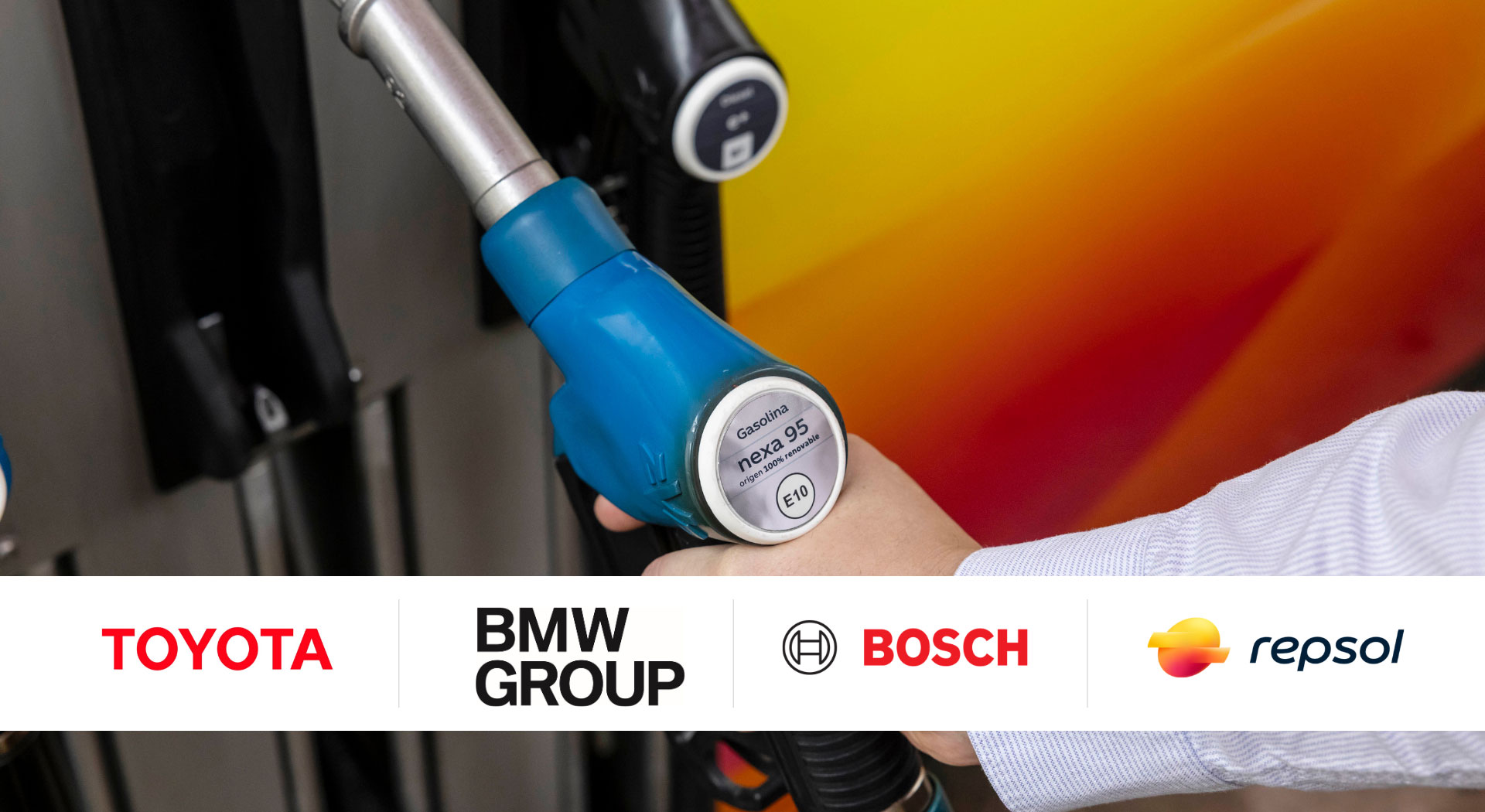
Toyota Motor Europe, BMW Group, Bosch and Repsol officially launched a six-month pilot on July 15, 2026, after fuelling began in early July. Around 20 Toyota, Lexus and BMW vehicles — supplied by Toyota España and BMW's own fleet — are running exclusively on Repsol's Nexa 95, described as a 100% renewable gasoline made from feedstocks compliant with the EU's Renewable Energy Directive. Crucially, it's designed as a true "drop-in" fuel: no engine modifications, no new pumps, no special handling. Bosch's "Digital Fuel Twin" system tracks and verifies fuel use across the vehicles, fuel stations and fuel-card transactions, under a framework the partners call VEEF — Vehicles running Exclusively on Eligible Fuels. Repsol is currently the only company selling this specific fuel at public stations in Spain, which is why the country was chosen for the trial.
The promise that came before it
This isn't the first time a major manufacturer has promised existing petrol engines could run dramatically cleaner without replacement. Porsche has spent since 2022 backing the Haru Oni plant in Punta Arenas, Chile — a genuinely different production process, using wind power to combine captured CO2 and hydrogen into synthetic gasoline. The published roadmap called for 55 million litres a year by 2026 and 550 million by 2027. As of independent reporting in May 2026, the plant's actual output was still around the same roughly 130,000 litres a year it produced when it opened — nowhere close to the 2026 target. A trade publication tracking e-fuel projects reported that Porsche's partner had quietly removed a line promising "mass production of e-fuels... from 2026" after being asked to explain the gap.
It's worth being precise here: Repsol's Nexa 95 and Porsche's Haru Oni fuel are not the same product. Repsol's is a renewable gasoline made mainly from sustainable biogenic and waste feedstocks; Porsche's is a true synthetic "e-fuel," built from renewable electricity, water and captured carbon. What they share is the underlying premise — an existing petrol engine, filled at an existing pump, running dramatically lower-carbon fuel with no hardware changes at all.
What we know
The Spain pilot is real, dated, and confirmed by four separate companies. Porsche's Haru Oni project has significantly and publicly missed its own stated output targets, and the missing target line on its supplier's website has been independently documented.
What this could mean
If the six-month Spanish trial produces usable real-world data, it strengthens the case that some share of Europe's roughly 250 million existing petrol cars could lower emissions without being scrapped or replaced — relevant at a moment when EU policy has focused almost entirely on electrifying new vehicles. The partners say pilot data will be shared with EU policymakers, which suggests this is also an attempt to shape future rules around how "renewable-fuel-only" vehicles are treated. Porsche's experience is a useful caution sitting right next to it: a well-funded, high-profile project with a name-brand backer still fell years behind its own published numbers.
What's still unknown
Whether renewable gasoline like Nexa 95 can be produced at a price and volume that matters beyond a 20-car pilot — Repsol remains its only public supplier, and only in Spain. Whether any of this reaches Greek or other EU forecourts, and at what price. And whether EU regulators will ultimately treat vehicles proven to run only on eligible renewable fuels any differently from ordinary petrol cars — nothing has been decided.
What this means for you, right now
Nothing changes at the pump today. Nexa 95 isn't sold in Greece, and no manufacturer is offering a retrofit renewable fuel for cars already on the road. What this pilot actually tests is whether "keep your existing petrol car, change what goes into the tank" is a realistic path for cutting emissions — or another version of a promise that quietly doesn't arrive, the way Porsche's did.
That's worth keeping in mind the next time a manufacturer markets a petrol car as "future-proof" because of some fuel technology on the horizon. On KAR AI, when you're comparing petrol models, it's fair to weigh those claims the same way you'd weigh a horsepower figure or a warranty term — as something to verify, not assume.
Continue your research
All articles →-
Industry News
Toyota Just Made Getting Into Motorsport Much Easier With the New GR KART
Toyota has launched the GR KART, an entry-level racing kart designed for children and families. At 2.150€, it brings GR branding, a 215cc engine and a surprisingly practical ownership package to the world of karting.

-
Industry News
BMW Never Built A Manual V10 X5. Twenty-Five Years Later, An Outsider Finally Did.
BMW had the X5, the V10, and a six-speed manual gearbox — it just never combined all three. A streetwear designer has now done what BMW's own M division never bothered to, dropping the E60 M5's engine into a rebuilt first-generation X5.
-
Industry News
How a Single Earthquake in Kyushu Just Knocked Out Toyota, Honda, and a Global Chipmaker at Once
A 7.1-magnitude earthquake in Kumamoto has halted Lexus production, shut a Honda motorcycle plant, and stopped a major chipmaker's cleanrooms — a live test of whether a decade of supply-chain fixes has actually freed Japan's auto industry from its oldest vulnerability.
