Do Students Really Need Exams to Learn?
A teacher joked that without exams students would do nothing all day. I checked what the data says about exam-heavy Greece and a Sweden that doesn't hang everything on one big exam.
Trusted by
The other day in chemistry class, someone said the lesson felt chill. A classmate said, "Yeah, that's how I like it," and added, "If only we didn't have exams too." The teacher laughed and said, "Yeah, so you could do nothing all day."
I've heard that idea my whole life in Greece: take the exams away and students stop learning. It never sounded right to me, so I looked at the numbers.
Two very different systems
In Sweden, students don't get grades until year 6, and there is no national university entrance exam. Getting into university mostly depends on your school grades, with an optional admissions test. Sweden does run national tests in years 3, 6 and 9, so it isn't a country without exams. It just doesn't hang the whole system on one.
In Greece, for most students, high school is built around the Panhellenics: a few exams in June that decide your future. I'm not doing them myself, I sit IAL exams, but I can see how deep that logic runs.
What the numbers say
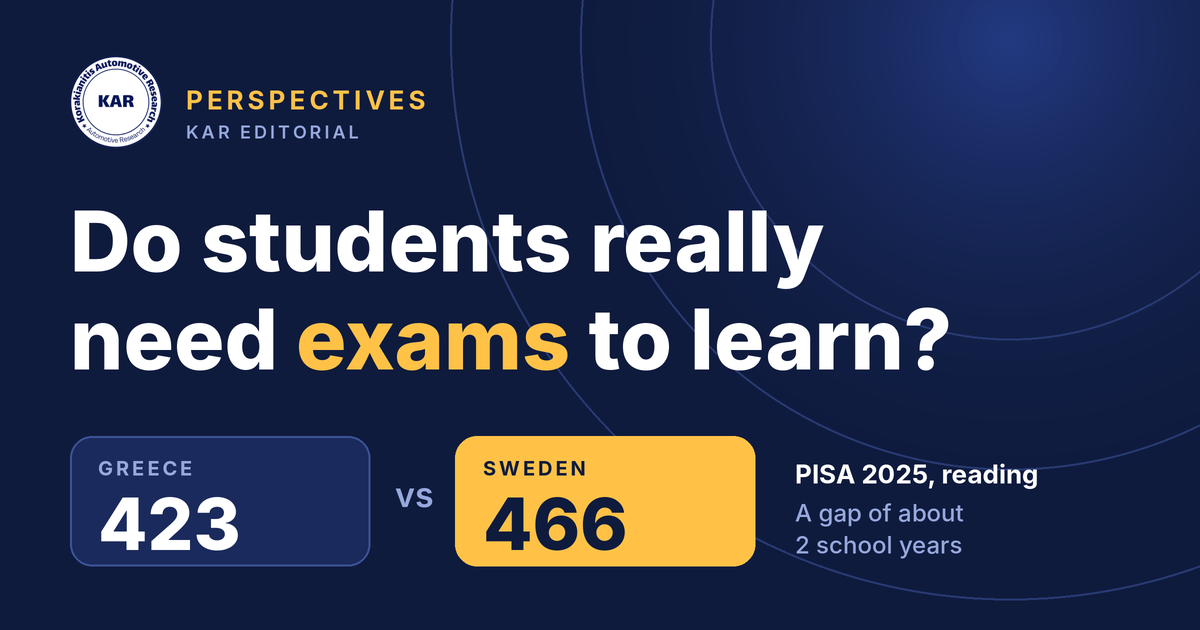
- Reading (PISA 2025): Sweden 466, Greece 423, OECD average 461. PISA treats about 20 points as roughly a year of school, so that gap is close to two years.
- Maths: nearly one in two Greek 15-year-olds is below the basic level, and Greece is under the OECD average in maths, reading and science.
- Creativity (PISA 2022, the first time it was tested): Greece scored 27 out of 60, the OECD average was 33. Finland, another Nordic country, scored 36.
- Innovation (Global Innovation Index 2025): Sweden is 2nd out of 139 countries. Greece is 42nd.
- Sustainable development (SDG Index 2025): Sweden is 2nd in the world. Greece is 28th in Europe.
What this doesn't prove
School is not the only reason for any of this. Economy, institutions and funding matter a lot, and I'm not claiming that removing exams creates a better country.
Sweden also has its own problems. Between 2022 and 2025 its scores fell by 21 points in reading and 18 in maths, and it is now only around the OECD average. So Sweden is not a model to copy.
The point is narrower. If exams alone were what made students learn, the most exam-driven systems should be at the top. They aren't.
Discipline is not fear
School has taught me discipline: getting through things you don't enjoy and finishing them anyway. That matters, and exams are part of it. But discipline and fear of failing are two different things.
A student who opens the book only because a test is coming learns how to pass tests. A student who wants to understand is the one who later builds something, invents something, fixes something.
Where this leaves us
This isn't about one teacher. It's a way of thinking a lot of us in Greece grew up with: without pressure, nobody works. As long as we believe that, school will stay about the fear of failing and not about learning, and that's why we won't really move forward.
So here's my question. If there were no exams tomorrow, would you still study?
Sources: OECD PISA 2025 (Greece and Sweden country notes), OECD PISA 2022 Creative Thinking (Greece), WIPO Global Innovation Index 2025, SDSN Sustainable Development Report 2025 and Europe Sustainable Development Report 2025.The other day in chemistry class, someone said the lesson felt chill. A classmate said, "Yeah, that's how I like it," and added, "If only we didn't have exams too." The teacher laughed and said, "Yeah, so you could do nothing all day."
I've heard that idea my whole life in Greece: take the exams away and students stop learning. It never sounded right to me, so I looked at the numbers.

Have something to say about cars too?
Write an article for KAR, free. We read it before it goes live, under your name.
Think something in this article infringes your copyright? Tell us.
Continue your research
All articles →-
Industry News
European Pricing Oddities And Hybrid Deals In Greece
We look at why Europe's best selling car costs thousands less in Greece, alongside a new pricing push for hybrid family SUVs.
-
Inside KAR
Under 18 and Building Something? This Is Your Way Into Barcelona 2027
If you're under 18 and building a product, a startup or a serious project, you don't have to do it alone. Project18 Europe connects Europe's best young founders, and 40 of them will meet in Barcelona in spring 2027. Here's why you should apply and how to do it in a few minutes.
-
Inside KAR
Qi Ziheng Joins KAR AI as Data Science Intern
A 14th-place finisher in Greece's 2025 national statistics competition, Qi Ziheng joins the KAR AI team as a data science intern on his way to studying Data Science at TUM.